Prynt Reveal · company identification
See which companies visit your site, and the evidence for each one.
Reveal names a company only when the visit comes from that company's own network, and shows you the network, the confidence and the reason behind every match. Visitors on home and mobile connections stay anonymous and never cost a credit.
People are linked only from your own forms and logins, never guessed. That is why Reveal works the same way in Europe and Latin America as in the US.
Free: 100 companies a month · No credit card · One script tag
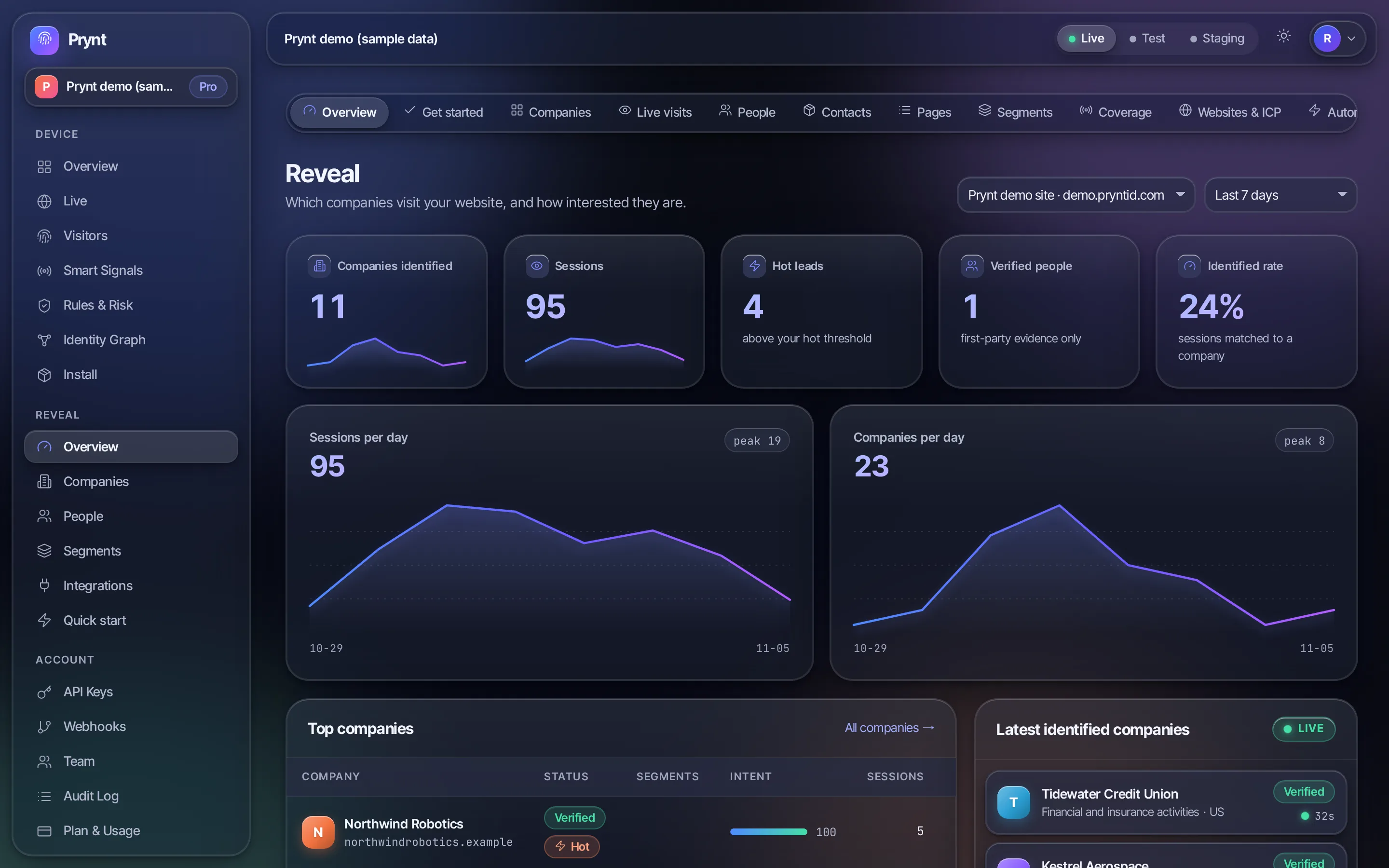
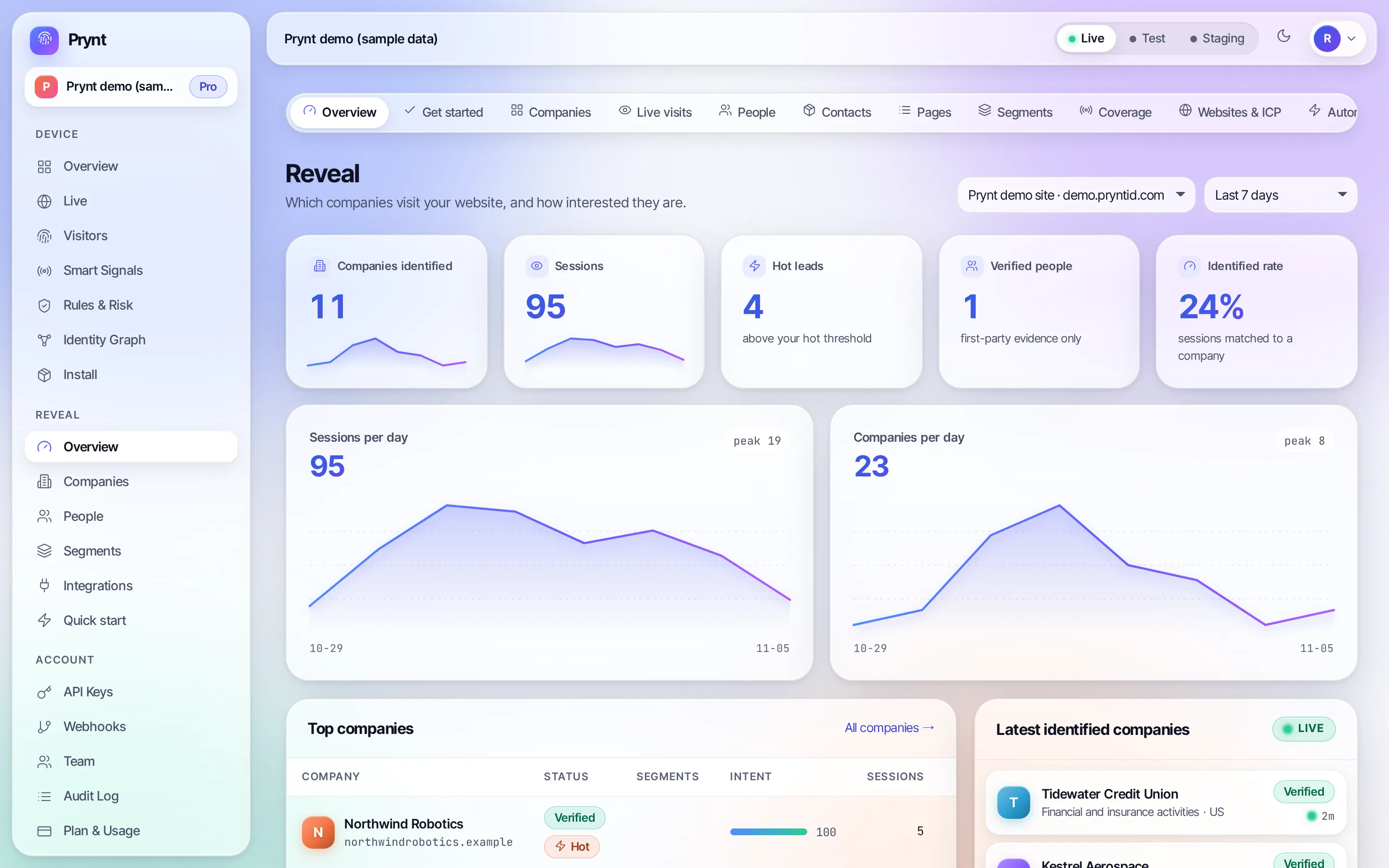 Sample data
What happens in the two seconds after someone lands on your pricing page
One visit, followed through the real pipeline. The company is fictional (sample data); the steps, field names and reason codes are the ones Reveal returns.
- 0
Before any of this: one line in your site's <head>
Google Tag Manager and WordPress (WPCode) work too. Verify your domain in the console and you are live.
<script src="https://api.pryntid.com/cdn/prynt-reveal.umd.js" async onload="PryntReveal.reveal({publicKey:'pk_live_…',website:'example.com'})"></script> - 1
The visit arrives
Someone in Rotterdam opens /pricing. The snippet sends the page path and how long they stay. The IP address is used for the lookup only; Reveal tables never store it raw.
Returned:
path: "/pricing" · country: "NL" · city: "Rotterdam" - 2
Which network is this?
The address is matched to its network (the ASN) and to the organisation that registered it.
Returned:
asnOrg: "BLUEFIN-LOG Bluefin Logistics B.V." - 3
What kind of network is it?
The class comes from data before keywords. bgp.tools and PeeringDB say whether the network belongs to a company, an ISP, a mobile carrier or a host. APNIC Labs' estimate of how many people use it settles the hard cases: 1,000 or more end users means an ISP, unless it is a known corporate network.
Returned:
asnType: "business" - 4
Company network, or not?
Only a company's own network can name the company. Everything else stays anonymous, costs no credit and says why, with one of these reasons:
isp_networkmobile_networkhosting_networkdatacentervpntorrelayverified_crawlershared_office
- 5
Confidence and evidence
A curated company network gives a verified match. A network whose registrant only looks like a business gives a likely match, with lower confidence. The method and the reasons travel with the record to the console, the API and every integration.
Returned:
status: "VERIFIED_COMPANY" · companyConfidence: 0.9 · method: "global_asn" · reasons: ["network_asn"] - 6
Intent score
Pages you marked as hot (pricing, security), pages read, time on site and earlier visits add up to an intent score. This account just crossed your hot threshold.
Returned:
intent: 74/100 · band: "hot" - 7
Your team hears about it
A rule sends the account to Slack, HubSpot, a signed webhook, n8n or Zapier, with a cooldown so nobody is paged twice for the same company.
What your team opens in the morning
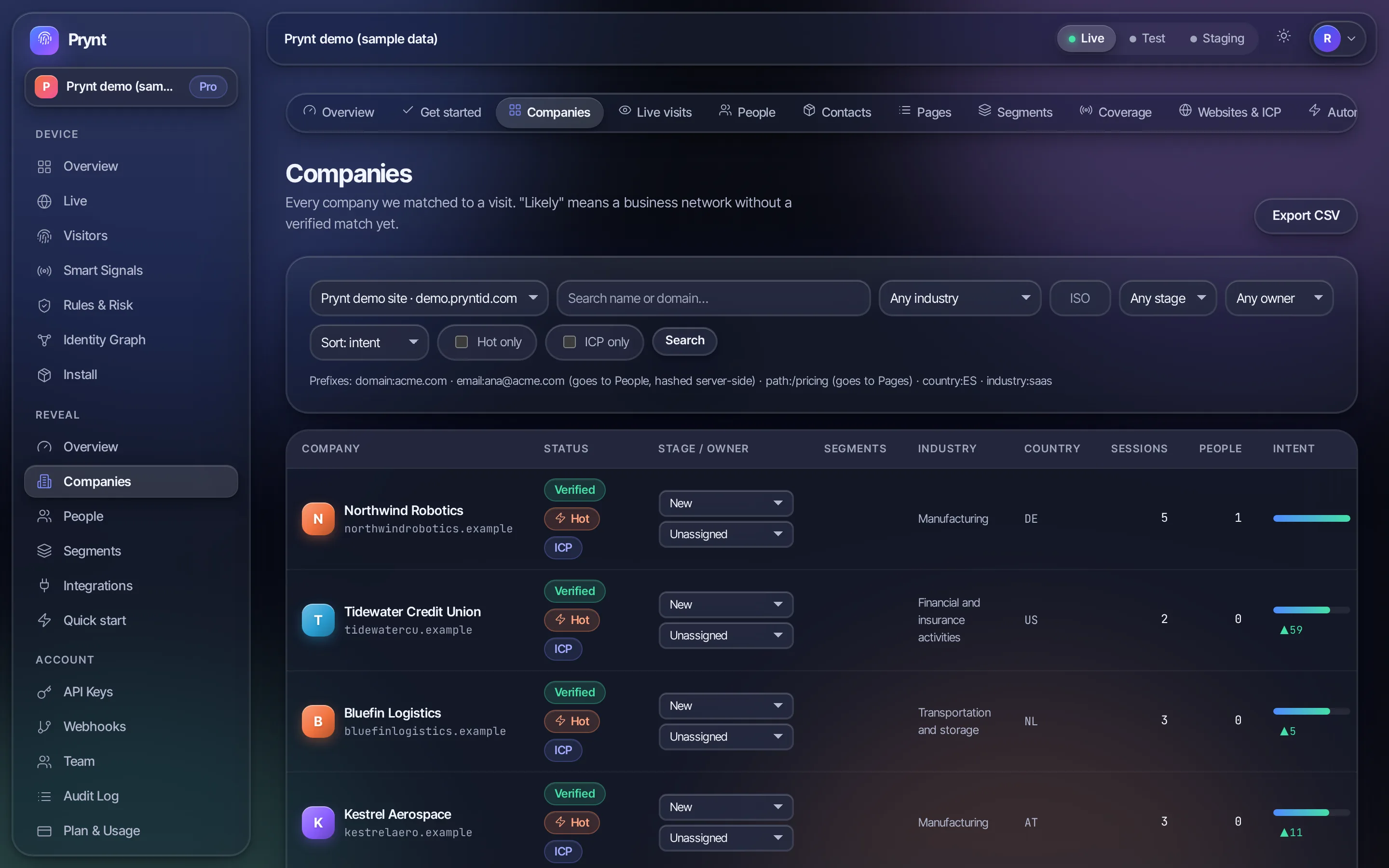
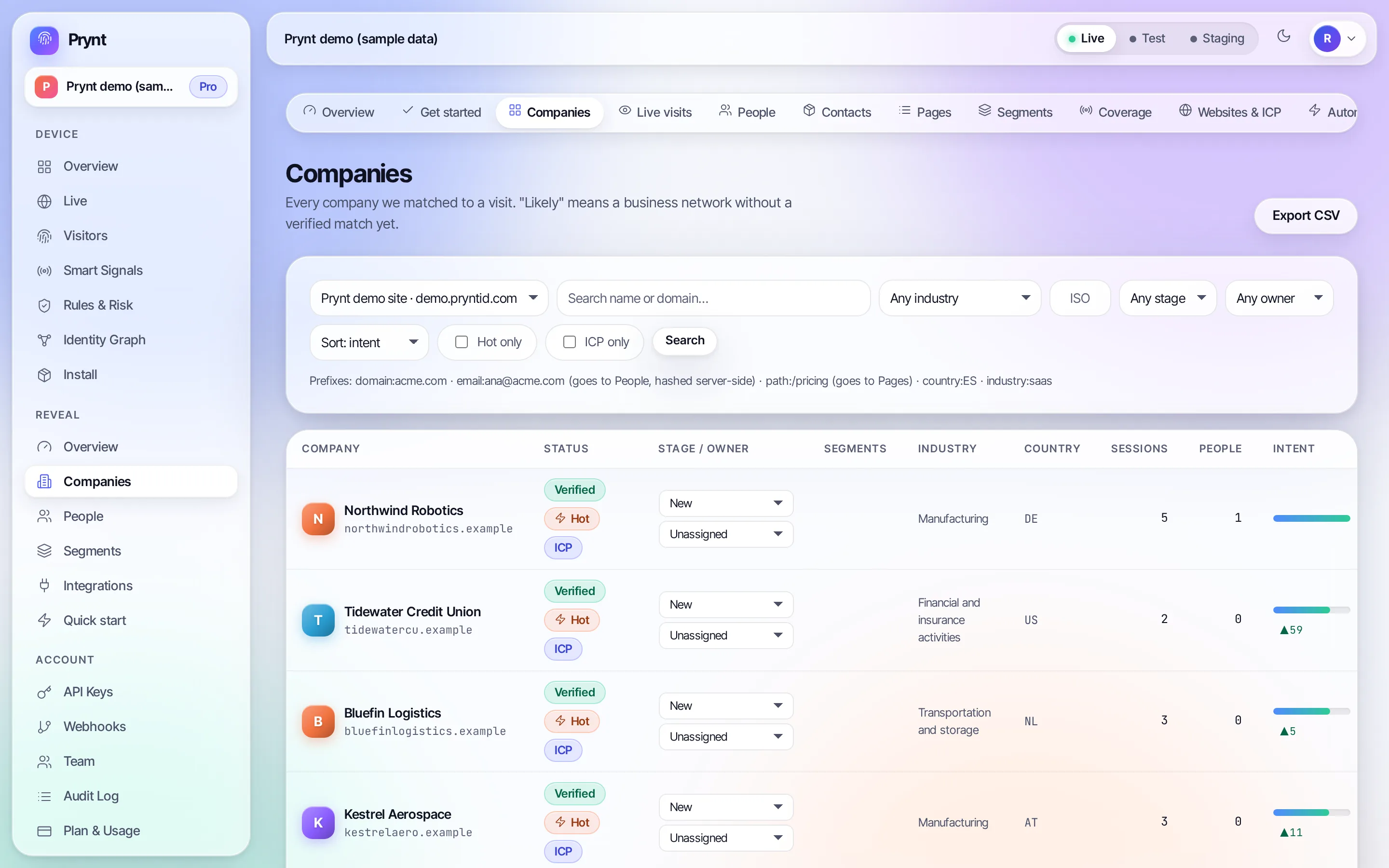 Sample data
Companies, ranked by what they read
Verified means a curated company network matched; Likely means the network's registrant looks like a business, with lower confidence. Industry, size and country come with each record. Filter by ICP, stage or hot pages, and export to CSV.
 Sample data
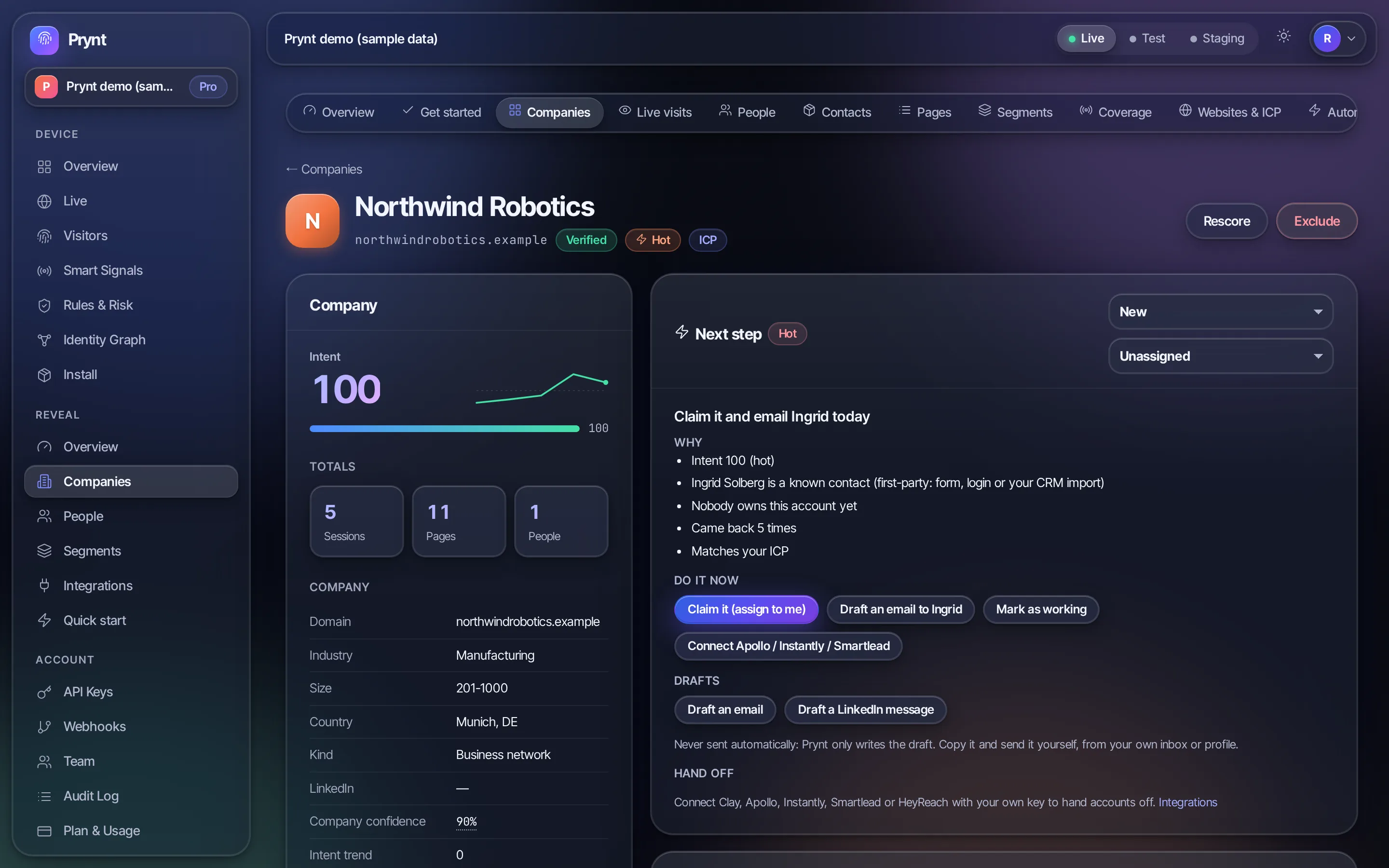
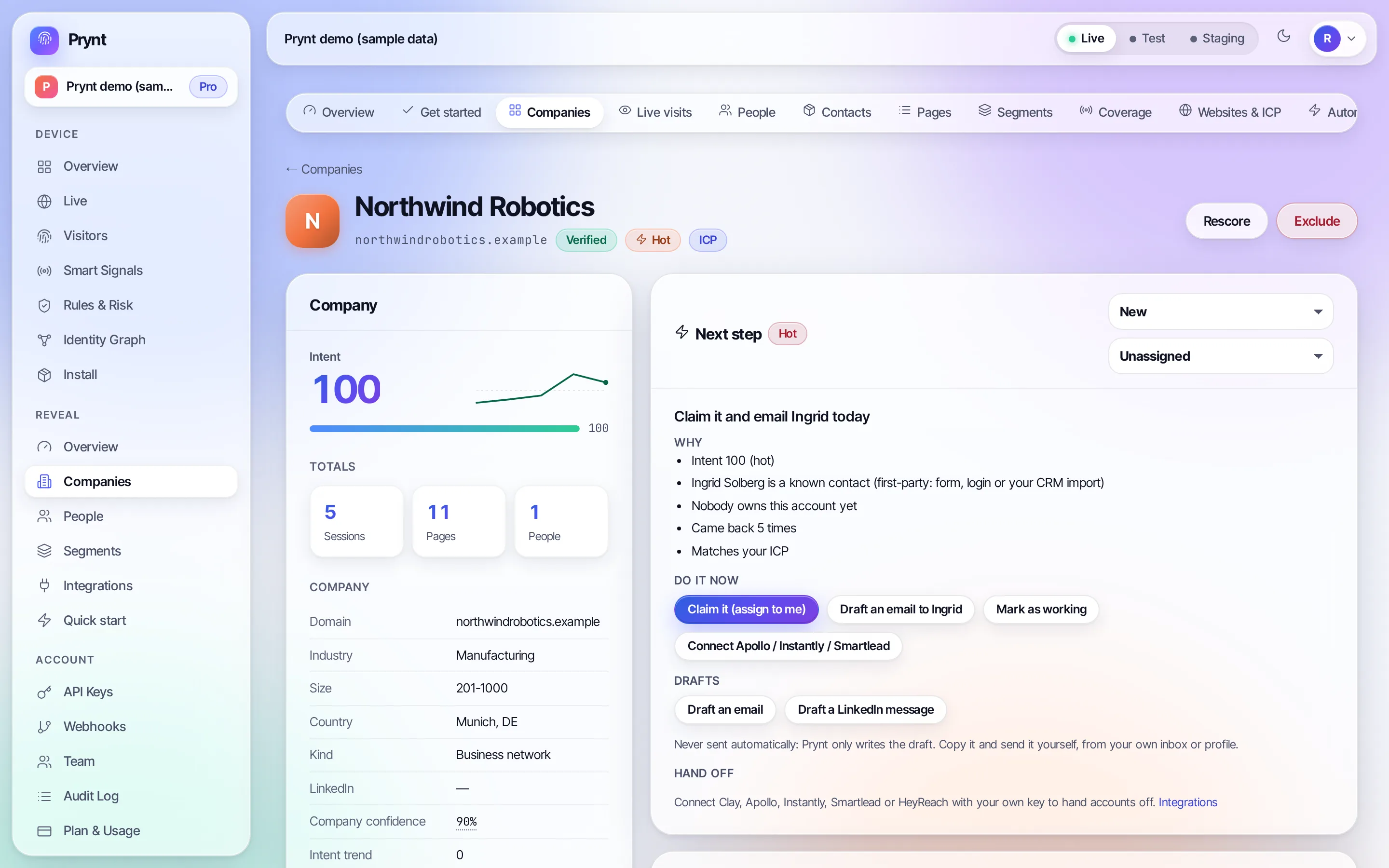
One page per account, with a next step
Every session and page, the confidence and where the data comes from. The playbook proposes what to do next. Here it says to email Ingrid: she asked for a demo through the site's own form, so she is a first-party contact. Reveal drafts the email; it never sends it for you.
Screenshots of the real Reveal console, logged in to a demo workspace. Its companies, people and networks are fictional.
What Reveal does, and what it will not do
Reveal does
- Name a company from network ownership, in any country, with its confidence and reasons.
- Show a person only when they gave you their details: your forms, your logins, a CRM import with consent.
- Keep home, mobile, hosting, VPN and Tor traffic anonymous, and free.
- Default to consent-off for EU, UK and Swiss visitors, and honour Global Privacy Control.
- Honour a public opt-out everywhere, immediately.
Reveal will not
- Guess who an anonymous visitor is, from a fingerprint, an IP address or bought data.
- Show a company for every visit. Most visits do not come from company networks, and we say so.
- Keep raw IP addresses in Reveal tables.
- Bill you automatically when the monthly allowance runs out.
- Promise an identification rate for your traffic. We publish our tests and their limits instead.
Reveal plans
A plan family of its own, independent of your Prynt device plan. One credit = one company identified on one website, once per calendar month (the allowance resets on the 1st, UTC).
| Free | Starter | GrowthRecommended | Scale | Enterprise | |
|---|---|---|---|---|---|
| Price | $0 / month | $49 / month | $129 / month | $299 / month | from $799 / month |
| Companies identified / month | 100 | 250 | 600 | 2,000 | negotiated |
| Websites | 1 | 1 | 2 | 5 | 50 |
| History | 7 days | 30 days | 90 days | 365 days | 365 days |
| Trial | — | 14 days | 14 days | — | — |
| Company identification with confidence + evidence | |||||
| Intent score, hot pages, ICP matching | |||||
| Public opt-out, suppressions, deletion requests | |||||
| Slack alerts | — | ||||
| Account timeline (pages, sessions, engagement) | — | ||||
| CSV export | — | ||||
| HubSpot (company + note) | — | — | |||
| Automation rules → signed webhooks, n8n, Zapier | — | — | |||
| First-party people: forms, logins, CRM import | |||||
| Companies API (server-side, secret key) | — | — | — | ||
| White-label | — | — | — | — | |
| Start free | Start Starter | Start Growth | Start Scale | Contact sales |
Introductory pricing. These prices are the launch proposal and may change after the first customers; a plan you subscribe to keeps its price for the term you paid. Extra companies: packs of 250 credits for $20 ($0.08 per company). Extra website: $19 / month, arranged through support. Annual billing: −15 %. There is no person price on any plan: people come only from your own first-party evidence (forms, logins, CRM import) and are included free on every plan, Free included. Reveal does not buy or resolve third-party identity data.
What a credit is — and what is never charged
One credit = one company identified on one of your websites, once per calendar month. The first session of a company on a site in a month charges one credit; every later session of that company on that site in the same month is free. The allowance resets on the 1st (UTC).
Never charged
- Repeat visits
- A company already identified on that site this month comes back as often as it likes: every later session is free.
- People
- First-party people (forms, logins, server-side identify, CRM import) are included on every plan, Free included. There is no person credit.
- Networks that are not companies
- ISPs, mobile carriers, hosting providers, VPN and Tor exits stay anonymous and cost nothing.
- Bots, exclusions and test keys
- Bots and crawlers, companies you excluded (your own domain, ICP exclusions), sessions that could not be resolved and anything sent with a test key are never charged.
When the allowance runs out
Nothing switches off. Sessions keep being recorded and resolved, but the company behind a new account stays locked: you see its industry, size and country and a counter of locked companies, not the name. Buy a pack of credits or upgrade and the locked companies unlock retroactively.
Packs carry over, no overage
Extra credits (250 for $20, $0.08 per company) are consumed after the monthly allowance and the unused part moves to the next month. There is no overage billing: Reveal never charges you for credits you did not buy, and nothing is billed automatically when you run out.
Credit questions
Does the same company on two of my websites cost two credits?
Yes. A credit is per company per website per calendar month: Acme on shop.example and on docs.example in November is two credits; Acme on shop.example twice in November is one.
What happens on the 1st of the month?
The monthly allowance of your plan resets. A company that comes back in the new month is a new credit on its first session. Credits from packs you bought are not reset: whatever was not used carries over.
I ran out mid-month. Did I lose the companies that visited afterwards?
No. Their sessions, pages and scores are stored; only the company identity is locked. Top up or upgrade and they unlock, including the ones that visited while you were out of credits.
Are credits charged for traffic on a test key?
No. Anything sent with a pk_test_ / sk_test_ key is resolved for your tests but never charged and never locked.
Is a person a credit?
No. Reveal sells company identification only. People come from your own first-party evidence and are included free on every plan; there is no person price anywhere.
What does the credit buy me technically?
A resolved company record (name, domain, industry, size, country, confidence, resolution method and reasons) on the account, in the console, in the API, in exports and in every integration you connected, for the whole month.
Questions about Reveal
How does Reveal identify a company?
From the network a session comes from. A corporate ASN, a curated network range or a first-party mapping you confirmed yields a VERIFIED_COMPANY or POTENTIAL_ACCOUNT with its own companyConfidence; residential, mobile, hosting, VPN and Tor traffic stays ANONYMOUS. The method and reasons are returned with every session.
Does Reveal tell me who the person was?
Only when you already know: a form submit, a login, a server-side identify call or a CRM import with a consent reference links the session to a person, and the record carries that evidence. Reveal never resolves an anonymous visitor to a name or email from fingerprints, IP addresses or purchased data.
What counts as a credit?
One company identified on one website, once per calendar month: the first session of a company on a site in a month charges one credit and every later session that month is free. Bots, ISPs, mobile carriers, hosting providers and VPN exits are classified anonymous and are never charged. When the monthly allowance runs out, sessions keep being recorded and the console shows the exhausted balance; nothing is billed automatically.
Which integrations exist today?
Slack, HubSpot (private app token: company + note), signed webhooks, n8n, Zapier catch hooks and email, plus CSV export and a companies API on Scale. Your existing Prynt webhooks also receive reveal.company_identified, reveal.hot_lead and reveal.person_verified. Microsoft Teams and Salesforce are not available yet.
Is it compliant in the EU, UK and Latin America?
Reveal is designed for company-level identification plus your own first-party people, which is the model that works outside the US. The SDK defaults to consent-off for European visitors and honours Global Privacy Control, raw IPs are not stored in Reveal tables, identifiers are salted and hashed, and a public opt-out applies platform-wide. Review it with your own counsel; we publish what the code does, not legal advice.
How accurate is it?
We do not promise an identification rate for your traffic: it depends on how many of your visitors browse from company networks, and on most sites that is a minority. What we publish is how we measure. On a public test set of 1,357 addresses the resolver reaches 99.7 % precision at “likely or better” and 100 % at “verified company”; those are upper bounds, not a prediction for your site. Our field test on two of our own websites reports every session, including the false positive it found. Every match ships with its confidence and evidence, so you can check it on your own traffic.
Do I need the Prynt device agent?
No. Prynt.reveal() runs on its own. If Prynt.load() is also on the page, Reveal reuses its visitorId so a returning device from a known account is recognised, without spending identification quota.
Can I use Reveal with my consent banner?
Yes. Pass consent as a boolean or a function that reads your CMP; with consent off the SDK sends only the page path, no referrer, UTM, engagement or identity. The console also sets a consent mode per website.
See which companies are on your site this week
Free plan, one website, 100 companies a month, 7 days of history. Verify your domain, paste the snippet and the first accounts appear as traffic arrives.